

Every agency that works on Shopify projects eventually hears a sentence that sounds harmless.
“Can you just connect our ERP?”
“We only need wholesale pricing.”
“The existing store is already working. We just need to move it to Shopify.”
“Can you make a small change to the checkout?”
On the surface, these requests sound like minor additions to an existing scope.
In reality, they can turn a straightforward Shopify project into weeks of additional development, testing, integration work, and project management.
The problem is rarely the client.
Most clients naturally describe requirements from a business perspective. They know what outcome they want, but they do not necessarily know what needs to happen technically behind the scenes.
For an agency, the real risk comes from accepting that simple description as the technical scope.
Before quoting the project, you need to understand what the request actually means.
Here are seven common Shopify requests that agencies should investigate carefully before saying, “Yes, that should be easy.”
1. “We Just Need to Move Our Existing Store to Shopify”
Migration is probably one of the best examples of a small sentence hiding a large project.
The client might see it as moving products from one website to another.
But what exactly needs to move?
Products?
Variants?
Collections?
Customers?
Historical orders?
Blog posts?
Product reviews?
Images?
Custom product fields?
Existing URLs?
SEO metadata?
Gift cards?
Subscriptions?
Customer-specific information?
And then there is the functionality surrounding that data.
A WooCommerce, Magento, BigCommerce, or custom-built store may rely on plugins, extensions, integrations, custom code, and business processes that do not have an exact one-to-one equivalent in Shopify.
That means the project is not simply:
Old store → Shopify
It is closer to:
Audit → Data Mapping → Functionality Mapping → Shopify Architecture → Migration → Redirects → Integration → QA → Launch → Monitoring
What the agency should ask before quoting
Start with:
- Which data needs to be migrated?
- How many products, variants, customers, and orders exist?
- Which existing plugins or extensions are business-critical?
- What custom functionality exists?
- Which systems are currently integrated?
- Does the client need historical order data?
- Which URLs currently generate organic traffic?
- What must work differently on Shopify?
A Shopify migration can become an excellent agency project.
But treating it like a glorified CSV import is one of the fastest ways to underestimate scope.
2. “Can You Just Connect Shopify to Our ERP?”
The word connect can mean almost anything.
One client may simply need Shopify orders sent to an ERP.
Another may expect real-time synchronization of:
- Products
- Inventory
- Customer records
- Customer-specific pricing
- Orders
- Fulfillment status
- Refunds
- Purchase orders
- Warehouses
- Shipping information
Then come the more important questions.
Which system is the source of truth?
What happens if data conflicts?
How frequently should information synchronize?
Does the ERP already have a reliable Shopify connector?
Does the integration need middleware?
Will custom API development be required?
How should failed synchronization be handled?
What happens when the ERP is temporarily unavailable?
Suddenly, “connect our ERP” is no longer one development task.
It is an integration architecture project.
What the agency should ask before quoting
Never estimate an ERP integration only from the name of the ERP.
Ask for:
- Required data flows
- Direction of synchronization
- Frequency of synchronization
- API documentation
- Existing connector availability
- Business rules
- Expected order volume
- Error-handling requirements
- Test or sandbox access
- Ownership of each data type
This is also one of the situations where having access to a specialist white-label Shopify development partner can significantly improve an agency’s ability to qualify the project before committing to a fixed scope.
3. “We Only Need Wholesale Pricing”
This one sounds especially simple.
The client wants retail customers to see one price and wholesale customers to see another.
Done, right?
Maybe.
But then discovery begins.
Does every wholesale customer receive the same price?
Or do different companies have negotiated pricing?
Can certain customers buy products that other companies cannot?
Are there minimum quantities?
Case-pack requirements?
Volume discounts?
Net payment terms?
Multiple buyers within one company?
Different pricing by company location?
International B2B customers?
A combined DTC and B2B storefront?
Now you are not implementing “a discount.”
You are designing a B2B purchasing model.
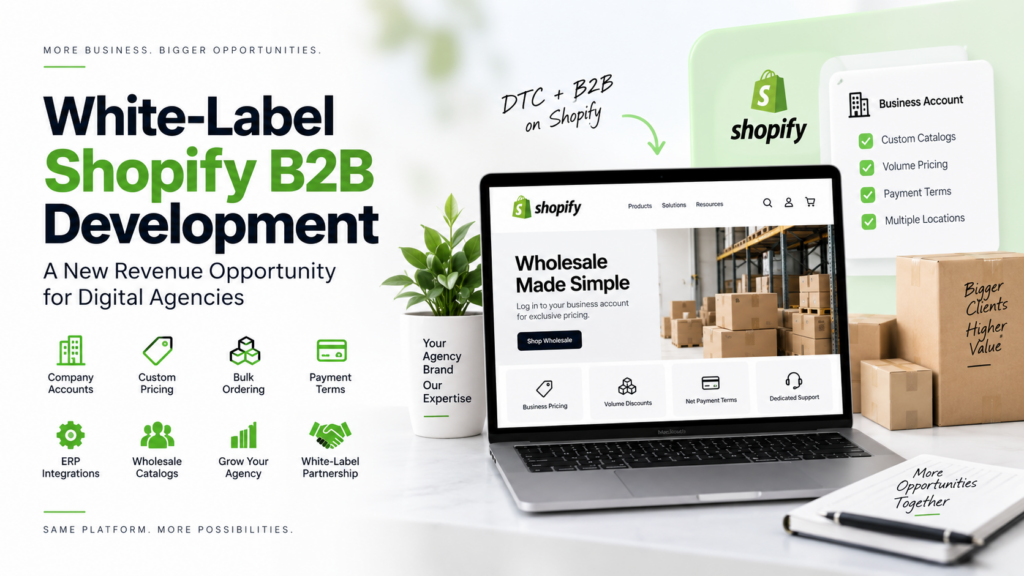
Shopify currently supports B2B capabilities including companies, catalogs, quantity rules, volume pricing and payment terms, but the exact features and limits available can depend on the merchant’s Shopify plan.
What the agency should ask before quoting
Ask the client to describe their actual wholesale sales process:
- Who are their different buyer types?
- How is pricing decided?
- Are prices customer-specific?
- Are there minimum or incremental quantities?
- Do buyers receive payment terms?
- Can multiple employees purchase for one company?
- Do wholesale buyers need different products?
- Will DTC and B2B customers use the same storefront?
Do not start with Shopify features.
Start with how the merchant actually sells.
4. “Can You Make a Small Change to the Checkout?”
Whenever the word “checkout” enters a Shopify scope, investigate before estimating.
Sometimes the request genuinely is simple.
Perhaps the merchant only wants branding changes or functionality that an existing compatible app already supports.
But other requests can involve:
- Custom fields
- Payment method rules
- Delivery logic
- Upsells
- Validation
- Conditional messaging
- B2B requirements
- Custom discounts
- Third-party services
- Post-purchase behavior
Shopify’s current checkout customization options differ depending on the store’s plan and the type of customization. For example, certain app-based customizations are available broadly, while deeper customizations to information, shipping, and payment stages remain Shopify Plus-specific.
So “we need a checkout customization” is not enough information to quote the work.
What the agency should ask before quoting
Clarify:
- Exactly where in checkout should the change appear?
- Is the requirement visual or functional?
- Does the logic affect shipping, discounts, or payments?
- What Shopify plan is the client using?
- Can an existing app solve it?
- Will Shopify Functions or a custom app be needed?
- What happens under different cart conditions?
A five-minute requirement conversation here can prevent a very expensive assumption later.
5. “We Want to Start Selling Internationally”
Adding another country to the shipping list is easy.
Building a proper international commerce experience is different.
The client may need:
- Multiple currencies
- Local pricing
- Country-specific products
- Different languages
- Regional domains or subfolders
- Market-specific theme content
- Shipping rules
- Taxes
- Duties
- Local payment expectations
- International SEO
Shopify Markets can customize experiences by market, including currency, product availability, domains, languages, pricing and other regional settings. Shopify also provides configurations for international domains, duties, and taxes.
That is powerful, but it also means an international project needs decisions that go beyond development.
What the agency should ask before quoting
Ask:
- Which countries are being launched?
- Will prices be converted or manually set?
- Are products available everywhere?
- Are translations required?
- What domain structure will be used?
- Who will provide translated content?
- How will duties be handled?
- Are shipping rules different by region?
- Does the merchant require localized creative or theme content?
- What is the SEO strategy for each market?
“Launch internationally” is often a strategy, development, operations, and SEO project combined.
6. “Can You Add Subscriptions?”
Subscriptions are another requirement that can range from easy to highly involved.
At the simplest level, the merchant may just need customers to receive the same product every month.
Shopify’s own Subscriptions app supports recurring purchases, multiple frequencies, discounts, and customer subscription management.
But many businesses need more.
For example:
- Build-your-own subscription boxes
- Prepaid subscriptions
- Different delivery and billing schedules
- Product swapping
- Custom subscription discounts
- Bundles
- Loyalty integration
- Customer portal customization
- Subscription analytics
- Migration from another subscription platform
- Complex fulfillment logic
Now the discussion is no longer simply about installing an app.
The agency needs to understand the business’s recurring revenue model.
What the agency should ask before quoting
Clarify:
- What exactly is being subscribed to?
- How often will customers pay?
- How often will products ship?
- Can customers skip, pause, swap, or cancel?
- Are bundles involved?
- Is subscription data being migrated?
- Does another system need subscription information?
- What should customers be able to manage themselves?
- Which app best matches the business model?
The app selection should follow the requirements — not the other way around.
7. “We Just Need One Custom Feature”
This might be the most dangerous request on the list.
Because “custom feature” tells you almost nothing about the effort involved.
Consider requests like:
“Customers should upload a file before ordering.”
“We need different discounts depending on customer type.”
“Dealers should only see products assigned to them.”
“We want orders automatically split between warehouses.”
“We need custom product configuration before Add to Cart.”
“We need our internal database to decide what products a customer can purchase.”
The visible feature may look small.
But behind it could be:
- Metafields
- Metaobjects
- Shopify Functions
- Theme development
- Custom apps
- APIs
- Webhooks
- External databases
- Customer authentication
- Business logic
- Admin interfaces
- Error handling
Shopify apps can extend different areas of the platform through extensions and Shopify Functions, including storefront, checkout, customer accounts and backend commerce logic.
The important question is not:
“How difficult does the feature look?”
It is:
“What needs to happen technically every time this feature runs?”
What the agency should ask before quoting
Turn the client’s idea into a workflow:
Trigger → Conditions → Data → Logic → Action → Result → Error Case
For example:
What triggers the feature?
Which customers does it apply to?
Where does the required data come from?
What business rules decide the outcome?
What happens after the action?
What happens when something fails?
Once the workflow is visible, the real scope usually becomes much clearer.
The Real Problem Isn’t Complexity – It’s Unidentified Complexity
Complex Shopify projects are not necessarily bad projects.
In fact, they can be some of the most valuable work an agency takes on.
The problem begins when complexity is discovered after the quote has already been approved.
That is when agencies start absorbing additional development hours, delaying deadlines, renegotiating scope, or telling clients that something they previously described as simple is actually much harder.
None of those conversations are ideal.
The better approach is to improve technical discovery before pricing.
When something sounds simple, investigate why.
Ask what happens before the action.
Ask what happens after it.
Ask which other systems are involved.
Ask who the different users are.
Ask where the data comes from.
Ask what happens when something fails.
The goal is not to make every Shopify project sound complicated.
It is to identify the complexity that already exists.
This Is Where the Right White-Label Shopify Partner Adds Value
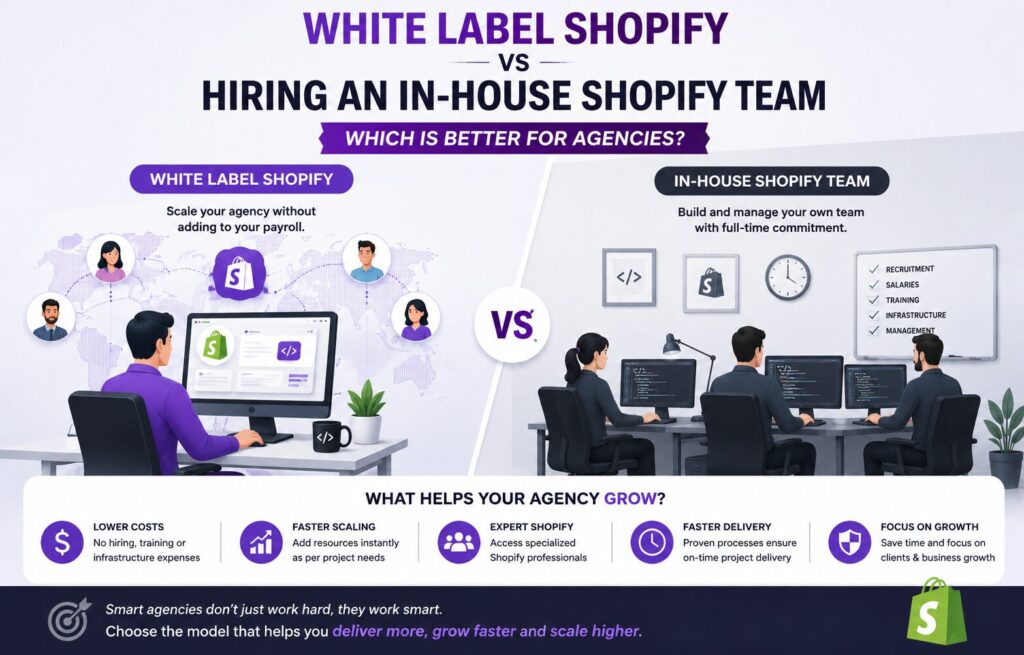
A strong white-label Shopify development partner should not simply appear after your agency has sold a project and send developers to complete tickets.
The relationship can create much more value earlier in the process.
A specialist partner can help your agency:
- Review technically complex requirements
- Assess feasibility before proposals are finalized
- Identify hidden dependencies
- Recommend native Shopify functionality versus apps or custom development
- Estimate integrations more accurately
- Evaluate Shopify plan limitations
- Plan migration architecture
- Scope custom Shopify functionality
- Participate behind the scenes during technical discovery
Your agency can continue owning strategy, design, communication, and the client relationship while bringing in deeper Shopify technical expertise when needed.
That is a much stronger model than discovering halfway through the project that a “small request” needs an entirely different technical approach.
Better Discovery Creates Better Shopify Projects
The difference between a profitable Shopify project and a painful one often starts before the contract is signed.
“Just migrate it.”
“Just connect it.”
“Just add wholesale.”
“Just customize checkout.”
“Just make it international.”
The word just is rarely a technical specification.
For agencies, the opportunity is not to avoid complex Shopify projects.
It is to become better at recognizing them.
When requirements are properly discovered, mapped, and estimated, complex Shopify work can become exactly the kind of higher-value project an agency wants to win.
And when the technical requirement goes beyond your team’s internal capability, working with an experienced white-label Shopify development team allows you to pursue those opportunities without giving up ownership of the client relationship.
At NTier Infotech, we work behind the scenes with digital agencies on Shopify development, migrations, B2B, integrations, custom functionality, Shopify Plus requiremƒents, and ongoing technical support.
Because sometimes the biggest Shopify projects start with the smallest sentence:
“It should only be a small change.”