

A business deciding to move from WooCommerce, Magento, BigCommerce, or another eCommerce platform to Shopify can represent a significant opportunity for a digital agency.
But Shopify migration projects are rarely just about transferring products from one platform to another.
A serious migration can involve products, customers, historical orders, collections, content, URLs, SEO equity, third-party apps, custom integrations, tracking, payment configuration, shipping rules, theme development, and extensive quality assurance.
The larger the store, the greater the potential complexity.
For agencies, this creates both an opportunity and a challenge.
Clients increasingly want one trusted agency to take responsibility for the entire replatforming process. However, not every web, design, marketing, or eCommerce agency has the specialist Shopify resources needed to confidently manage every technical part of a migration.
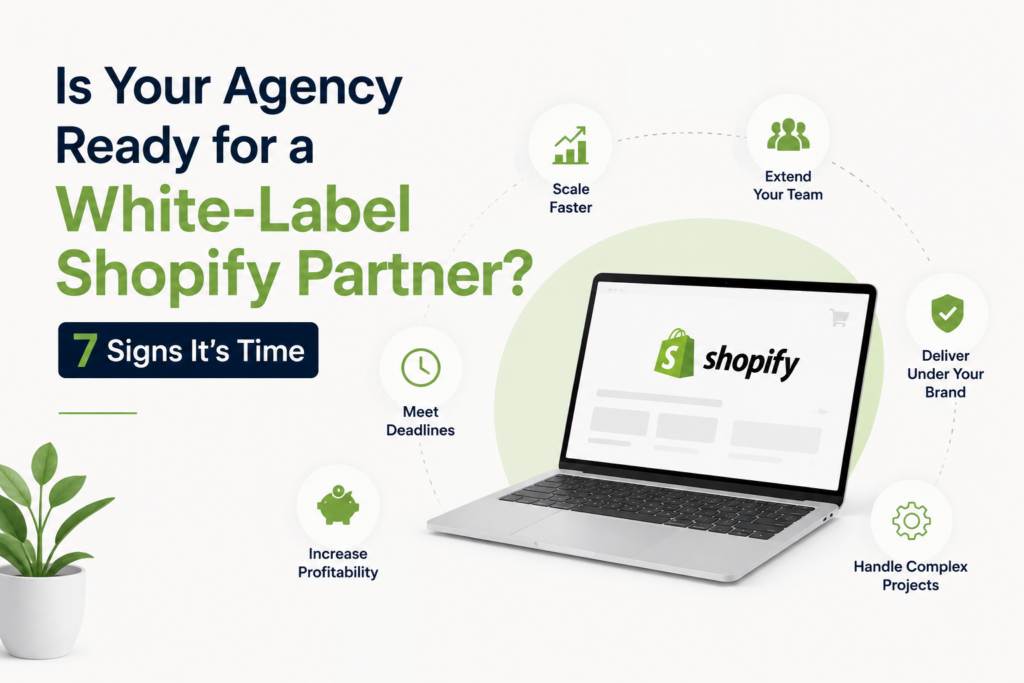
This is where white-label Shopify development can create a practical advantage.
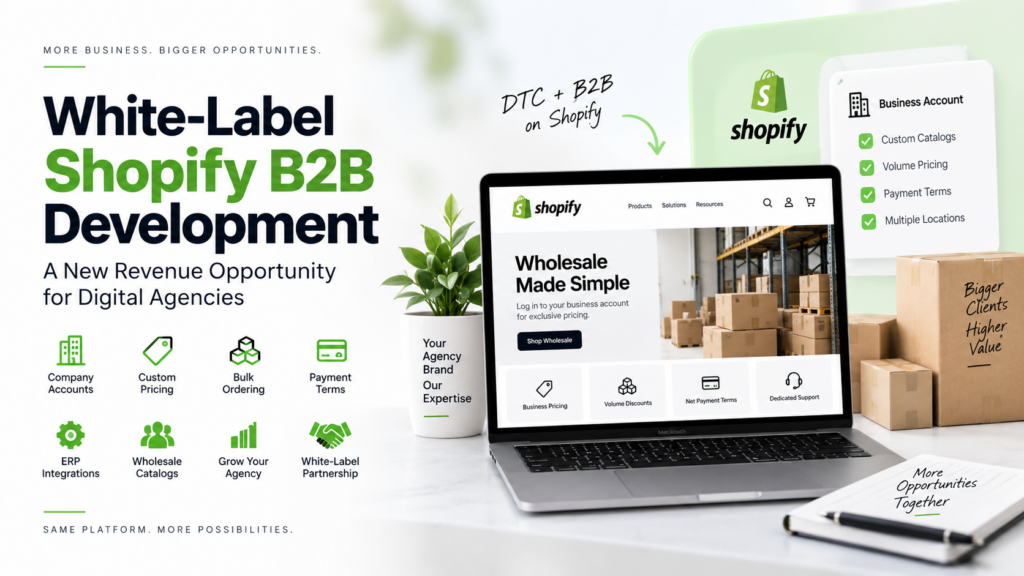
With the right white-label Shopify partner, an agency can maintain ownership of the client relationship while adding the technical expertise required to deliver complex Shopify migration projects behind the scenes.
Shopify Migration Is More Than Moving Store Data
One of the biggest mistakes an agency can make is treating migration as a simple data transfer exercise.
Moving the catalog is important, but it is only one part of the project.
A typical Shopify migration may involve:
- Products and variants
- Collections and categories
- Customer accounts
- Historical orders
- Blog content
- CMS pages
- Product images and media
- Gift cards or store credit requirements
- Existing URLs
- SEO metadata
- Navigation
- Reviews
- Apps and integrations
- Shipping configuration
- Taxes
- Payment gateways
- Analytics and tracking
- Custom business workflows
Shopify’s own migration guidance recommends reviewing what data and content needs to move before selecting the migration method. Depending on complexity, merchants can use CSV imports, migration apps, Shopify Partners, or custom solutions built with Shopify APIs.
For an agency, this means Shopify migration should be approached as a replatforming project, not simply an import task.
Understanding that difference is important if you want to win larger migration opportunities.
Why Shopify Migration Projects Are Valuable for Agencies
Migration projects often touch almost every part of an eCommerce business.
That naturally expands the potential scope of work.
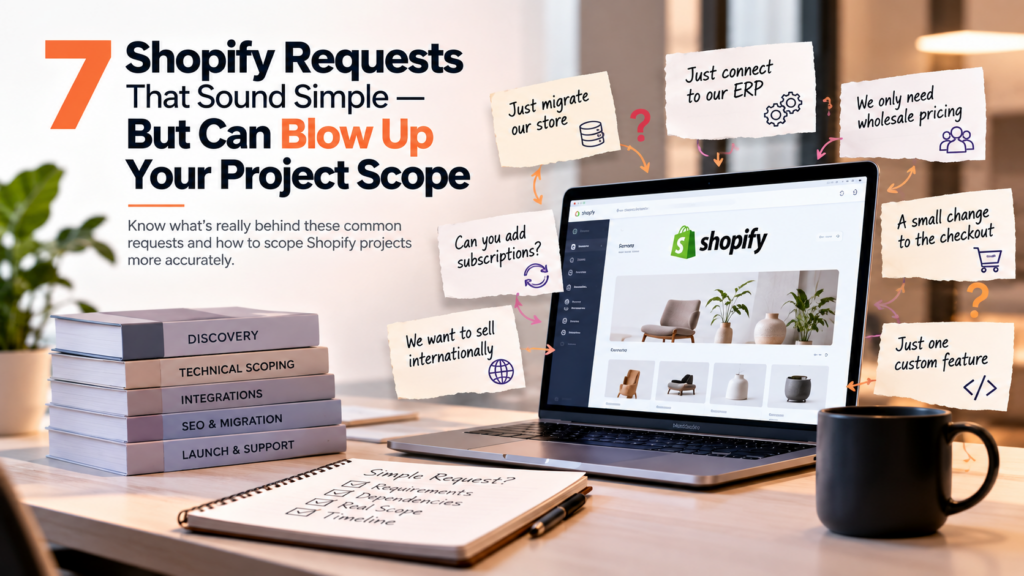
A client might initially approach your agency because they want to migrate from WooCommerce to Shopify.
During discovery, you may find they also need:
- A complete storefront redesign
- Shopify theme development
- Conversion improvements
- New navigation and collection architecture
- App selection and configuration
- ERP or CRM integrations
- Analytics implementation
- Technical SEO
- Performance optimization
- Subscription functionality
- B2B capabilities
- International storefront configuration
- Post-launch maintenance
What looked like a migration project can therefore become a much broader Shopify engagement.
That makes migrations particularly interesting for agencies looking to expand their Shopify service offering.
The challenge is being confident that your agency can actually deliver everything promised.
Where Agencies Commonly Get Stuck
Agencies do not always lose Shopify migration projects because they cannot design a good website.
More often, the problem appears when technical questions begin during discovery.
The client asks:
How will our historical orders migrate?
What happens to our existing URLs?
Can our current ERP integrate with Shopify?
Can our existing subscription setup be recreated?
What happens to customer passwords?
Can our custom product data be moved?
Will our SEO rankings be affected?
How much downtime should we expect?
How will you validate thousands of products after migration?
Can our existing warehouse workflow continue?
These are not questions that should be answered with assumptions.
They require technical assessment.
If an agency has strong strategy, design, marketing, and client management capabilities but limited Shopify migration expertise, a white-label Shopify development partner can fill that technical gap during both discovery and implementation.
1. Start With a Proper Migration Discovery Process
Winning more Shopify migration projects starts before development.
It starts with discovery.
Before quoting a project, the agency needs to understand the client’s existing commerce ecosystem.
That includes more than asking how many products they have.
A useful migration discovery should examine:
Current platform:
Is the merchant using WooCommerce, Magento, BigCommerce, a custom platform, or another system?
Catalog complexity:
How many products, variants, collections, custom attributes, images, and product relationships exist?
Customer and order data:
How much historical data needs to be retained, and in what form?
Apps and extensions:
Which existing tools support subscriptions, reviews, loyalty, search, filtering, B2B, shipping, marketing, or other functionality?
Integrations:
Does the business connect its store with ERP, CRM, PIM, warehouse, accounting, or fulfillment systems?
Custom functionality:
Which workflows were built specifically for the existing platform?
SEO:
Which URLs currently receive organic traffic and backlinks?
International requirements:
Does the merchant operate across different currencies, languages, domains, or markets?
This discovery process helps separate a straightforward migration from a complex replatforming project.
It also helps the agency price the work more accurately.
2. Map Existing Functionality Before Rebuilding It
Clients often assume everything on their existing platform needs to be recreated exactly on Shopify.
That is not always the best approach.
Some functionality may already exist natively in Shopify.
Some may require an app.
Some may need custom development.
And some old functionality may no longer be necessary at all.
Before development begins, create a functionality map.
For every major existing feature, decide whether the Shopify solution should be:
- Native Shopify functionality
- Theme functionality
- A Shopify app
- Custom Liquid or JavaScript
- A custom Shopify app
- A third-party integration
- A redesigned business process
This exercise can dramatically improve project planning.
It also gives agencies an opportunity to demonstrate expertise.
Instead of simply rebuilding the old store, you are helping the client decide what their new Shopify architecture should look like.
3. Treat Data Migration as a Structured Technical Workstream
Data migration deserves its own planning, testing, and validation process.
Shopify supports migration of important commerce data such as products, customers, historical orders, content, and other store information through different methods depending on the source platform and project complexity.
But importing data does not automatically mean the migration is complete.
The migrated information needs validation.
For example:
Are all products present?
Are variants correctly connected?
Did images migrate successfully?
Are prices accurate?
Are customer records complete?
Are product handles correct?
Did custom product attributes map correctly?
Are collections populated properly?
Are historical orders represented as expected?
Large catalogs make manual checking difficult, so a repeatable QA process becomes essential.
This is one area where an experienced white-label Shopify development team can provide considerable value to an agency.
4. Make SEO Preservation Part of the Migration Plan
SEO is one of the biggest concerns clients have when changing eCommerce platforms.
URLs often change when moving to Shopify.
A product that previously lived at one URL structure may have a different path after migration.
Without proper planning, existing links can lead to 404 pages.
That affects users, backlinks, search engines, and potentially organic traffic.
A Shopify migration should therefore include:
- Existing URL crawl and inventory
- Identification of important landing pages
- Old-to-new URL mapping
- 301 redirect planning
- Metadata review
- Canonical checks
- Internal link review
- Sitemap validation
- 404 monitoring after launch
Shopify supports URL redirects specifically so traffic from old or changed URLs can be directed to relevant new pages. Its migration checklist also explicitly recommends creating redirects where required.
SEO should not be something the team remembers the day before launch.
It should be part of the migration architecture from the beginning.
For agencies with SEO teams, this can become another strength when pitching Shopify replatforming projects.
5. Do Not Underestimate Apps and Integrations
A merchant’s old platform may have accumulated years of extensions, plugins, custom code, and integrations.
Not all of them will have direct Shopify equivalents.
Before migration, the agency should audit the existing technology stack.
For every application or integration, ask:
What business problem does this solve?
Does Shopify already provide this functionality?
Is there an appropriate Shopify app?
Does the external platform have an existing Shopify integration?
Will custom API development be required?
Can the workflow be simplified?
This is particularly important for systems such as:
- ERP
- CRM
- PIM
- Subscription platforms
- Search tools
- Loyalty programs
- Review platforms
- Inventory systems
- Warehouse systems
- Shipping platforms
- Accounting software
- Marketing automation
- Analytics platforms
Complex integration requirements are often where a basic website migration becomes a specialist Shopify development project.
A capable white-label Shopify partner allows an agency to pursue those projects without pretending that every integration can be solved with an off-the-shelf app.
6. Build QA Into the Project From the Beginning
Migration QA should not consist of opening the homepage and placing one test order.
Testing needs to cover both data and functionality.
Depending on the project, this may include:
Catalog QA: products, variants, images, pricing, collections, metafields and inventory.
Storefront QA: navigation, search, filtering, responsive layouts, product pages, collection pages and content pages.
Commerce QA: cart, discounts, shipping, taxes, payments and checkout.
Integration QA: ERP, CRM, subscriptions, fulfillment and external services.
Tracking QA: analytics, pixels, conversion tracking and consent functionality.
SEO QA: redirects, metadata, canonicals, robots directives, sitemap and 404 errors.
Device QA: desktop, tablet and mobile experiences.
A structured QA process is one of the biggest differences between simply moving a website and professionally managing a replatforming project.
7. Plan the Launch and Post-Migration Period
The migration does not end when the new Shopify store goes live.
The first days after launch are critical.
Teams should be monitoring areas such as:
- Failed redirects
- 404 errors
- Checkout issues
- Payment failures
- Inventory synchronization
- Integration errors
- Tracking accuracy
- Customer account issues
- Order processing
- Site performance
- Unexpected app conflicts
This is also why agencies should avoid treating Shopify migrations as fixed projects that disappear after launch.
They can naturally lead into ongoing Shopify support.
Post-launch services may include:
- Shopify maintenance
- Conversion optimization
- Theme enhancements
- App management
- Integration support
- Performance improvements
- SEO monitoring
- New feature development
A successful migration can therefore become the beginning of a longer client relationship.
How White-Label Shopify Development Helps Agencies Win These Projects
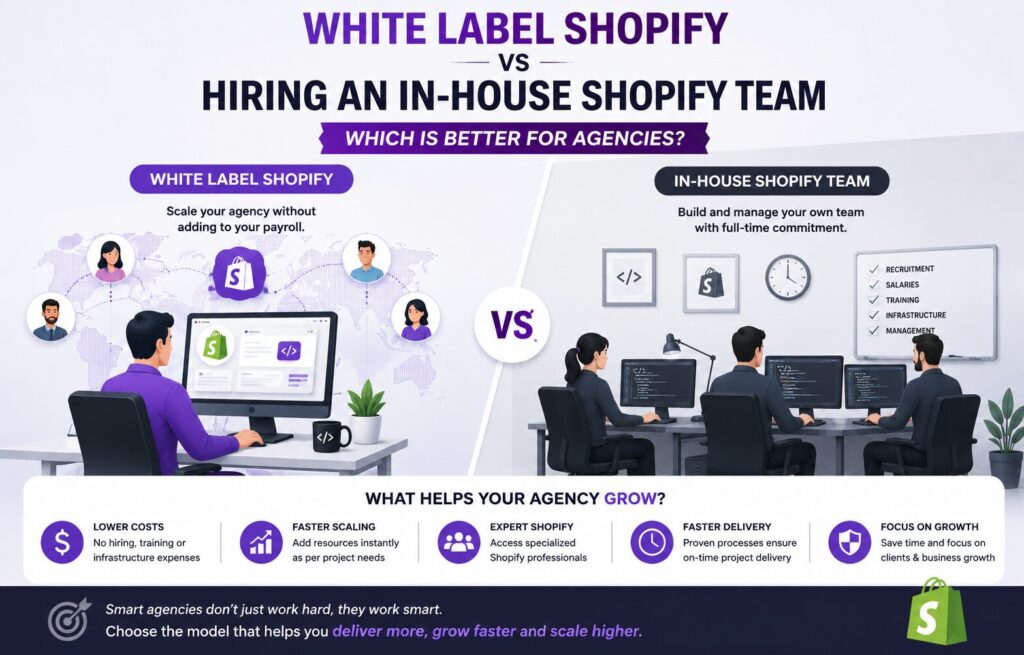
The biggest benefit of a white-label arrangement is not simply additional development capacity.
It is access to capability.
Your agency may already be excellent at:
- Client acquisition
- Account management
- UX strategy
- UI design
- Branding
- Marketing
- SEO
- Content
- Project management
You do not need to replace those strengths.
A white-label Shopify development partner can complement them with technical services such as:
- Shopify migration planning
- Data migration
- Theme development
- Custom functionality
- Shopify app development
- API integrations
- Third-party system integrations
- Migration QA
- Technical deployment
- Post-launch support
The client can continue working with your agency while the technical Shopify team operates behind the scenes.
This allows agencies to offer more complete Shopify migration services without immediately building every specialist capability internally.
From Migration Vendor to Long-Term Shopify Partner
There is an important positioning difference here.
If your agency sells a migration as:
“We will move your products from your current platform to Shopify.”
you are competing largely on execution and price.
If instead you sell:
“We will help you replatform your commerce operation to Shopify while protecting critical data, functionality, integrations, SEO, and customer experience.”
the conversation changes.
You are no longer selling data transfer.
You are selling a controlled business transition.
That creates room for strategy, technical expertise, design, development, integrations, testing, and ongoing optimization.
And that is where migration projects can become significantly more valuable for an agency.
Turn Shopify Migration Demand Into an Agency Growth Opportunity
Shopify officially recognizes store migration as a dedicated Partner service, and its own migration guidance includes working with a Shopify Partner as an option for merchants that need professional or custom migration support.
For agencies, that represents a clear opportunity.
You may already have clients considering a move from WooCommerce, Magento, BigCommerce, or another platform.
The question is whether your agency has the technical depth to confidently take ownership of the complete project.
With the right white-label Shopify development model, the answer does not have to depend entirely on the size of your internal Shopify team.
At NTier Infotech, we work behind the scenes with agencies that need reliable Shopify development expertise for migrations, custom storefronts, integrations, technical implementation, QA, and ongoing support.
A strong white-label Shopify partner can help your agency move beyond simple Shopify builds and confidently pursue more technically demanding migration and replatforming opportunities while keeping the client relationship under your own brand.