
For years, many digital agencies have focused their Shopify services primarily on direct-to-consumer businesses.
That makes sense. Shopify became widely known as a platform for consumer brands selling fashion, beauty products, electronics, home goods, jewellery, food, and thousands of other products directly to shoppers.
But Shopify is increasingly becoming relevant to another major eCommerce segment: business-to-business commerce.
Manufacturers, distributors, wholesalers, commercial suppliers, and brands that sell both directly to consumers and to business buyers are looking for better ways to move traditionally manual B2B purchasing processes online.
For digital agencies, this creates an interesting opportunity.
An agency that already provides Shopify design, development, branding, marketing, or eCommerce services can potentially add Shopify B2B implementation to its service portfolio.
And agencies do not necessarily need to build an entire specialist B2B development department before pursuing those projects.
With the right white-label Shopify development partner, agencies can combine their existing client relationships and strategy capabilities with specialist technical expertise behind the scenes.
That creates the potential for a new, higher-value Shopify service line.
Why Shopify B2B Is Becoming More Relevant to Agencies
B2B eCommerce projects have traditionally been more complicated than standard consumer stores.
Business buyers may need different products, negotiated pricing, bulk quantities, purchase permissions, payment terms, tax rules, multiple locations, purchase orders, ERP connectivity, and account-specific experiences.
Historically, solving these requirements often meant combining an eCommerce platform with multiple external systems or custom development.
Shopify’s B2B capabilities are changing that conversation.
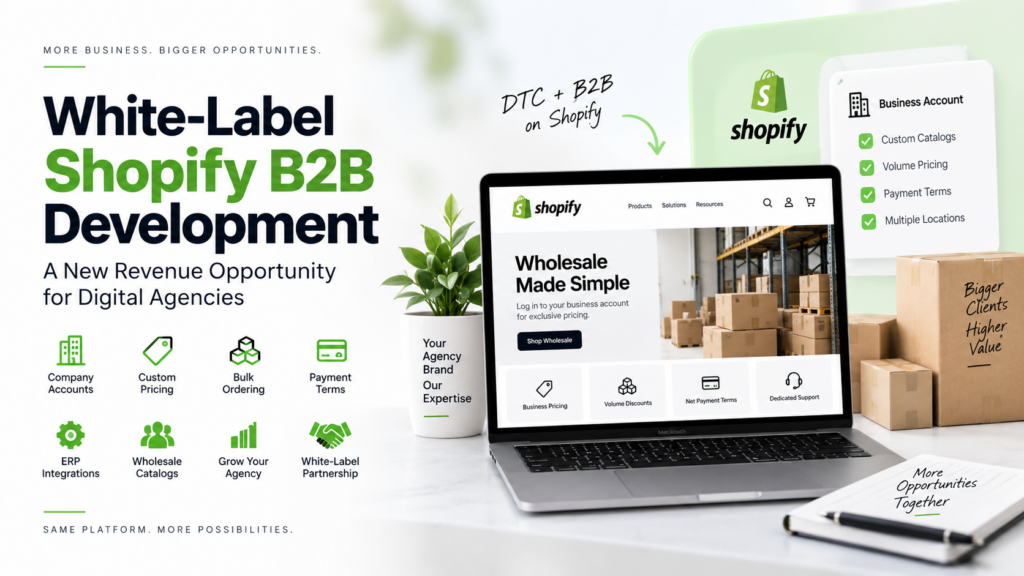
Shopify can now support features such as company accounts, B2B catalogs, customized product availability, volume pricing, quantity rules, payment terms, self-service ordering, customer accounts, Shopify Flow automation, and integrations with ERP and external business systems.
For agencies, the significance is bigger than simply having another Shopify feature to sell.
It means businesses that previously might not have considered Shopify for wholesale or B2B operations may now become potential Shopify clients.
That can create opportunities across several types of projects:
- Businesses launching B2B eCommerce for the first time
- DTC brands adding a wholesale channel
- Traditional wholesalers replacing manual ordering processes
- Companies combining B2B and DTC commerce
- Businesses migrating from legacy B2B platforms
- Existing Shopify merchants improving their wholesale workflows
- Larger organizations integrating Shopify with ERP, CRM, PIM, inventory, or finance systems
Each of these can become a valuable agency engagement.
B2B Projects Can Expand the Value of an Existing Shopify Client
One of the most interesting opportunities may already exist inside an agency’s current client base.
Consider a Shopify brand that sells directly to consumers but also receives wholesale enquiries from retailers.
Perhaps wholesale orders currently happen through email, spreadsheets, phone calls, PDFs, or manually created invoices.
The client may not even think of this process as an eCommerce problem.
An agency that understands Shopify B2B can identify the opportunity and propose a more structured digital buying experience.
Instead of only supporting the client’s consumer storefront, the agency can potentially help create:
- Business customer accounts
- Wholesale product catalogs
- B2B-specific pricing
- Volume discounts
- Minimum and incremental quantity rules
- Net payment terms
- Repeat ordering workflows
- Customer-specific purchasing experiences
- B2B storefront customization
- Automated workflows
- Business system integrations
Suddenly, the agency is not simply maintaining a Shopify theme.
It is helping the client digitize another part of its revenue operation.
That can significantly expand both the scope and strategic value of the relationship.
What Shopify B2B Services Can Agencies Offer?
Shopify B2B should not be viewed as a single development service.
There are several areas where agencies can create individual projects or packaged service offerings.
1. Shopify B2B Setup and Configuration
Some businesses already operate on Shopify but have never properly configured their B2B capabilities.
An agency can help assess the existing store, understand the merchant’s wholesale model, and configure the appropriate B2B structure.
This may include setting up companies, company locations, catalogs, pricing structures, quantity rules, payment terms, and customer accounts.
For smaller businesses entering wholesale eCommerce, this alone can be a meaningful project.
2. Combined B2B and DTC Store Experiences
Many merchants do not want separate systems for consumer and wholesale customers.
They want one commerce platform while still giving each audience a different buying experience.
A consumer may need standard retail pricing and promotional merchandising.
A wholesale customer may need business-specific products, negotiated pricing, higher quantities, payment terms, and account-specific information.
Designing these experiences correctly requires more than simply enabling a setting.
The storefront needs to recognize who is shopping and present the appropriate navigation, content, products, pricing, and purchasing journey.
That creates opportunities for UX strategy, theme customization, Liquid development, account experiences, and testing.
3. Custom B2B Storefront Development
Standard functionality may cover many requirements, but businesses often have unique workflows.
A merchant may need custom account dashboards, specialized product information, quick-order interfaces, reorder functionality, business-specific content, advanced product filtering, or customized purchasing workflows.
These requirements can turn a simple setup project into a larger custom Shopify development engagement.
For agencies already providing UI/UX and design services, this is particularly valuable.
The agency can own the customer experience and creative direction while a white-label Shopify development team handles the technical implementation.
4. B2B Pricing and Catalog Architecture
Wholesale pricing is rarely as simple as applying one discount to every product.
Different buyers may have different agreements.
A distributor may receive one price structure while a smaller retailer receives another.
Some buyers may have access to products that others cannot purchase.
There may also be minimum quantities, case packs, volume discounts, regional pricing, and product-specific rules.
Designing the correct catalog and pricing architecture is therefore an important part of B2B implementation.
Agencies that can translate commercial requirements into a reliable Shopify configuration can provide significantly more value than agencies offering basic theme development alone.
5. ERP, CRM and Business System Integrations
This is where B2B projects can become substantially more technical.
B2B merchants often rely on existing systems for inventory, accounting, warehousing, customer records, product information, fulfillment, or sales operations.
Shopify may need to exchange data with:
- ERP platforms
- CRM systems
- Warehouse management systems
- PIM platforms
- Accounting software
- Fulfillment providers
- Custom internal applications
- Product or inventory databases
For example, an ERP may remain the source of truth for inventory and customer-specific pricing while Shopify provides the online ordering experience.
Orders may then need to flow back into the ERP automatically.
Projects like these require API knowledge, careful data mapping, error handling, synchronization strategy, and extensive testing.
This is one area where access to specialist Shopify developers can dramatically expand what an agency is able to offer.
Why B2B Development Requires More Than Standard Shopify Skills
A designer who can build a beautiful Shopify storefront is valuable.
A developer who understands Liquid and theme customization is also valuable.
But complex B2B projects often require a broader technical skill set.
Developers may need to understand Shopify APIs, customer and company data, catalogs, Markets, metafields, metaobjects, Shopify Flow, checkout behavior, external systems, custom applications, authentication, data synchronization, and business-specific purchasing logic.
The project also needs to account for real business operations.
What happens when inventory changes?
Where does customer pricing come from?
Who controls credit terms?
Can different employees from the same company place orders?
Does every business location use the same pricing?
How are taxes handled?
Where are orders fulfilled?
Which system owns customer data?
These questions go beyond storefront design.
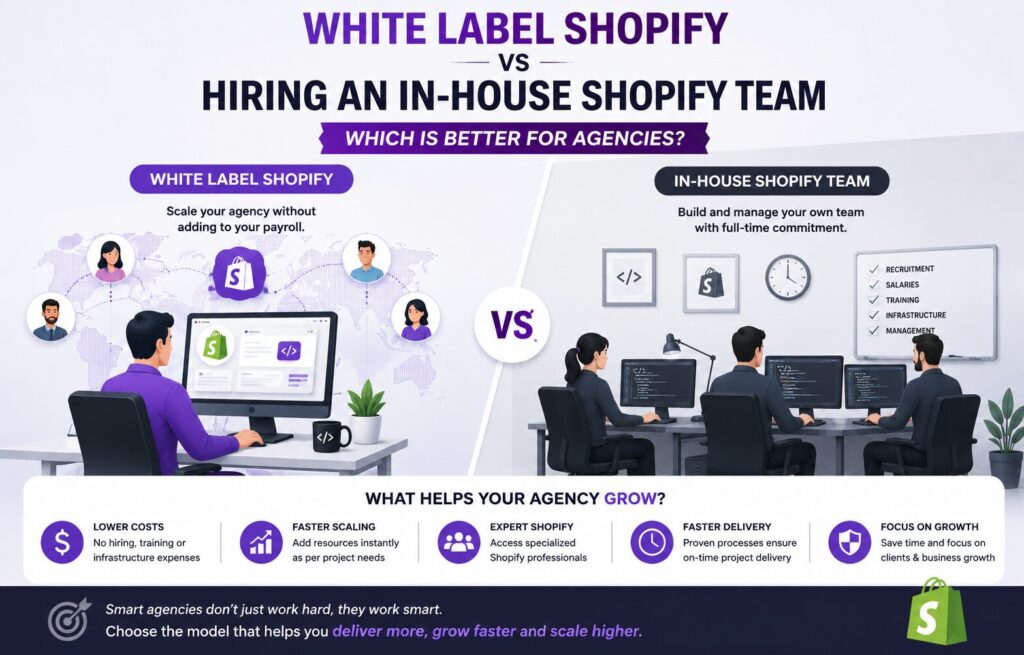
For agencies that occasionally encounter this level of Shopify work, hiring permanent specialists for every technical area may not be practical.
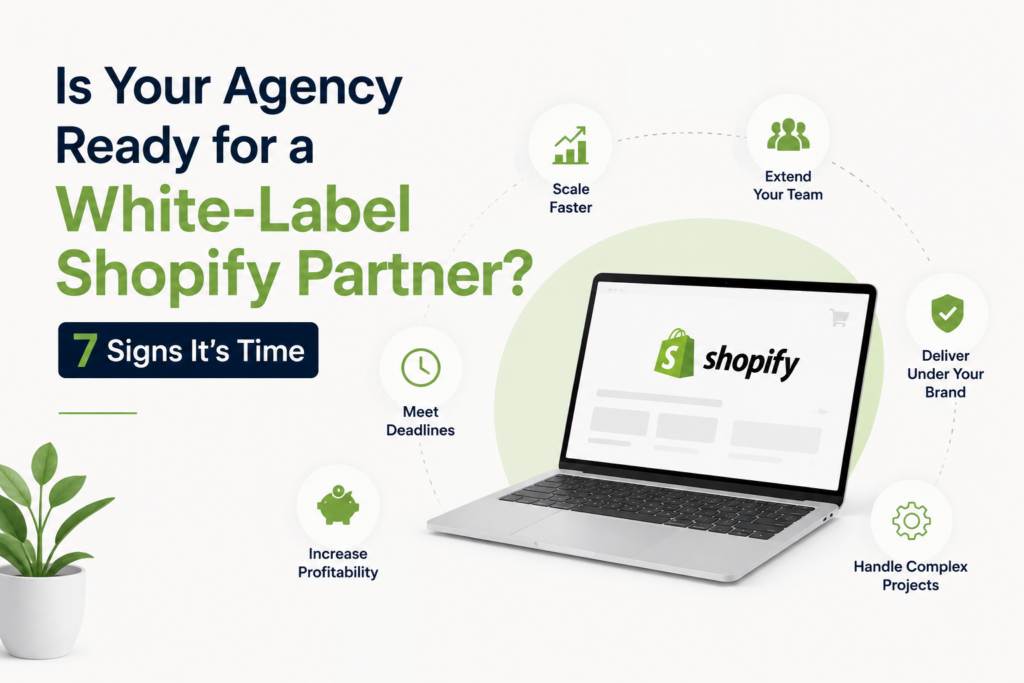
This is where a white-label Shopify B2B development service model becomes particularly useful.
How White-Label Development Changes the Opportunity
White-label development allows an agency to provide Shopify B2B services under its own client relationship while using an external technical team for implementation.
The agency might handle:
- Client acquisition
- Discovery
- Account management
- Strategy
- Branding
- UI/UX
- Design
- Project direction
The white-label development partner can support areas such as:
- Technical discovery
- Shopify architecture
- Theme development
- B2B configuration
- Custom functionality
- API development
- Integrations
- Data migration
- QA
- Deployment
- Technical support
The exact responsibilities can vary depending on the agency.
A design agency may outsource nearly all development.
A full-service digital agency may only need help with integrations and more advanced Shopify functionality.
A development agency may use a white-label partner simply to provide additional capacity on larger B2B projects.
The advantage is flexibility.
The agency can build a Shopify B2B offering around its existing strengths instead of trying to recreate every capability internally from day one.
Which Agencies Can Benefit Most?
Shopify B2B is not only an opportunity for existing Shopify agencies.
It can also complement several other types of digital businesses.
Branding and Design Agencies
These agencies may already create identities, packaging, websites, and digital experiences for manufacturers and product businesses.
Adding Shopify B2B development allows them to take those clients further into commerce.
Marketing Agencies
A marketing agency may already manage paid advertising, SEO, content, email marketing, or growth strategy for eCommerce businesses.
When a client decides to launch wholesale eCommerce, the agency can potentially retain ownership of the broader digital relationship.
WordPress and Web Development Agencies
Existing clients may eventually request Shopify or eCommerce capabilities outside the agency’s primary technical stack.
A white-label relationship provides a way to expand without abandoning the client’s existing relationship.
Shopify Agencies
Even established Shopify agencies may not have deep internal experience with B2B architecture, ERP integrations, custom applications, or high-complexity development.
White-label specialists can fill those gaps when required.
B2B Can Also Create Recurring Revenue After Launch
Another advantage of Shopify B2B projects is that the relationship rarely needs to end at launch.
As the merchant’s wholesale channel grows, new requirements often appear.
New customer groups may require different pricing.
The business may expand internationally.
Additional systems may need integration.
Automations may need improvement.
New products, locations, catalogs, sales channels, and workflows may be introduced.
This can create opportunities for recurring services such as:
- Shopify maintenance
- Development retainers
- Feature enhancements
- Integration monitoring
- Performance optimization
- Conversion improvements
- B2B UX optimization
- Technical support
- Storefront updates
- Ongoing automation
For an agency, this means a B2B implementation can develop into a long-term client relationship rather than a one-time website build.
Start With the Business Process, Not the Shopify Feature List
One mistake agencies should avoid is selling B2B simply as a collection of Shopify features.
The better conversation starts with the merchant’s existing sales process.
How do wholesale customers place orders today?
How is pricing determined?
Which products can each customer buy?
Are orders entered manually?
How are payment terms handled?
Does the business use an ERP?
How much staff time is spent processing repeat orders?
Where do errors occur?
What would the ideal buyer experience look like?
Once those questions are answered, Shopify technology can be mapped to the actual business problem.
This positions the agency as a strategic commerce partner rather than simply another Shopify developer.
It can also uncover larger opportunities involving custom development, integration, automation, UX, migration, and ongoing optimization.
A New Service Line Without Building Everything From Scratch
The growth opportunity around Shopify B2B does not mean every agency needs to immediately hire a large team of B2B developers.
A more practical approach can be to build the capability gradually.
Start by identifying relevant opportunities within your current client base.
Develop a clear B2B discovery process.
Define which services your agency wants to own internally.
Then use a specialist white-label Shopify partner to provide the technical depth or additional capacity required behind the scenes.
As project volume grows, your agency can decide which capabilities make sense to bring in-house and which are better supported through partnerships.
This allows the service line to grow based on real client demand rather than speculative hiring.
Turn Shopify B2B Into a New Agency Growth Opportunity
Shopify B2B represents more than another feature set within the Shopify ecosystem.
For digital agencies, it can open access to new types of clients, larger technical engagements, deeper relationships with existing merchants, and recurring development opportunities after launch.
The strongest opportunity may be for agencies that already understand strategy, design, marketing, or eCommerce but need additional Shopify technical expertise to confidently deliver complex B2B implementations.
A white-label development model allows those agencies to enter the market without building every capability internally first.
At NTier Infotech, we support agencies behind the scenes with Shopify development, custom functionality, integrations, migrations, B2B implementations, and ongoing technical support.
Whether your client is adding wholesale to an existing Shopify store or building a more sophisticated B2B commerce experience, the right technical partnership can help your agency take ownership of the opportunity while keeping the client relationship under your brand.