
Growing an agency is exciting until new opportunities start creating more pressure than progress.
A new Shopify project lands in your inbox. Then another client asks for a custom integration. An existing customer suddenly needs ongoing Shopify support. Your designers are ready, your account managers are confident, and the client wants to move quickly.
There is just one problem: your development capacity is already stretched.
Many agencies reach this stage before they realize they have a resource problem. The instinctive response is often to hire another developer or start searching for freelancers. But hiring takes time, freelancers can be inconsistent, and building an entire Shopify team may not make financial sense when project demand fluctuates.
This is where a white-label Shopify partnership can become valuable.
The key question is not simply whether white-label development is useful. The more important question is:
Is your agency actually at the stage where partnering with a white-label Shopify team makes sense?
Here are seven signs that can help you decide.
1. Your Shopify Project Pipeline Is Growing Faster Than Your Team
One of the clearest signs is simple: you have more Shopify opportunities than your current team can comfortably handle.
This often happens when an agency starts gaining momentum.
Perhaps your agency originally focused on branding, SEO, paid marketing, WordPress development, UI/UX, or general web development. Over time, more clients begin asking for Shopify stores, redesigns, migrations, integrations, or ongoing eCommerce development.
That is a positive problem to have.
But if your internal development capacity cannot grow at the same pace, that opportunity can quickly turn into operational pressure.
You may start delaying project start dates, extending timelines, or assigning Shopify projects to developers who are already working at full capacity.
That approach may work temporarily, but it is difficult to sustain.
A white-label Shopify development partner can provide additional technical capacity when required without forcing your agency to immediately build a larger permanent team.
Instead of limiting the number of projects you accept based only on internal availability, your agency gains access to an extended development team that can support additional workload.
The important signal here is not simply that your agency is busy.
It is that demand is repeatedly exceeding your available delivery capacity.
When that starts happening consistently, it may be time to consider a development partnership.
2. You Are Turning Down Shopify Projects You Could Otherwise Win
Every agency has projects it should reject.
Some projects are outside your expertise. Some have unrealistic budgets or timelines. Others simply are not a good fit.
But there is a major difference between rejecting a bad-fit project and rejecting a good opportunity because you do not have enough Shopify development resources.
Imagine one of your existing clients asks your agency to redesign their Shopify store.
You already manage their branding, SEO, or digital marketing. They trust your team and would prefer to keep the project with your agency.
But because you do not have enough Shopify developers internally, you refer the development work elsewhere.
That does not only mean losing one project.
You may also be introducing another agency or developer into an existing client relationship.
Over time, those missed opportunities can add up.
A white-label Shopify partner allows agencies to expand the range of Shopify projects they can confidently accept while maintaining ownership of the client relationship.
Your agency can continue managing strategy, communication, design, and project direction while a specialist development team handles the technical execution behind the scenes.
If your agency regularly hears itself saying:
“We could probably win this project, but we do not have the technical resources right now.”
that may be one of the strongest signs that a white-label partnership deserves serious consideration.
3. Your Existing Developers Are Constantly Overloaded
A full project pipeline can look like growth from the outside while creating serious problems internally.
Developers jumping between multiple client projects often have to manage bug fixes, urgent change requests, new feature development, QA tasks, deployment work, and support tickets at the same time.
Eventually, something starts slipping.
Deadlines become harder to meet.
Testing becomes rushed.
Small development requests sit in the queue longer than they should.
Developers spend more time switching between tasks than actually completing them.
This does not necessarily mean you need to hire immediately.
In many agencies, workload is not perfectly predictable. One month may bring several Shopify builds, while the next month is dominated by marketing or design work.
Hiring full-time developers purely to cover peak workload can increase fixed costs significantly.
White-label support offers another option.
An external Shopify development team can handle selected projects, development tasks, maintenance work, or overflow capacity while your internal developers remain focused on core priorities.
The goal should not be to replace your team.
The goal is to prevent growth from turning your strongest team members into permanent bottlenecks.
4. Shopify Projects Are Becoming More Technically Complex
Not every Shopify project requires advanced development.
Many stores can be built successfully using a quality theme, Shopify’s native features, carefully selected apps, and straightforward Liquid customization.
But client requirements often become more complex as your agency attracts larger businesses.
A project may suddenly involve:
- Advanced Shopify theme customization
- Shopify Plus functionality
- Custom sections and complex product templates
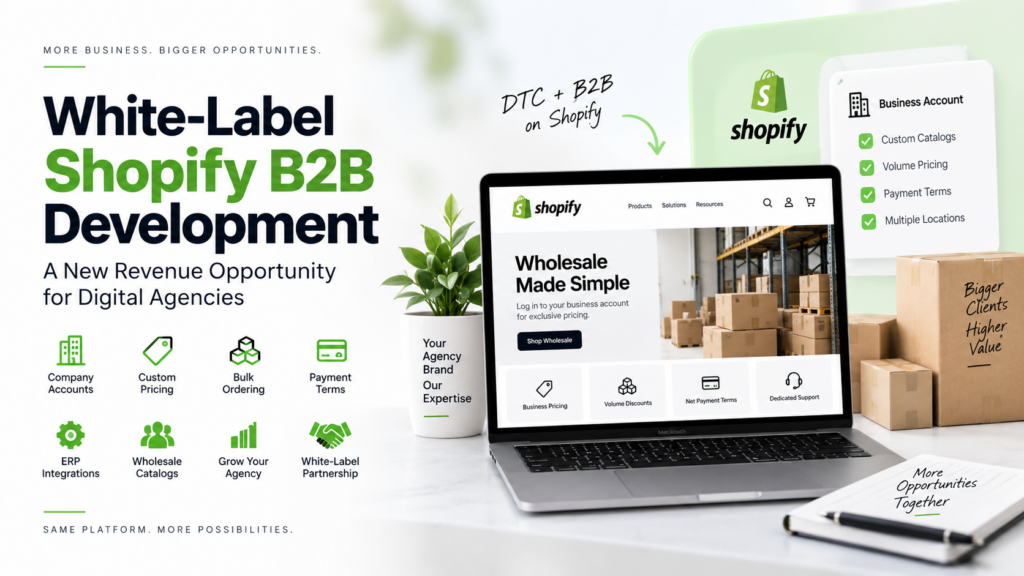
- Shopify B2B requirements
- Third-party API integrations
- ERP or CRM integrations
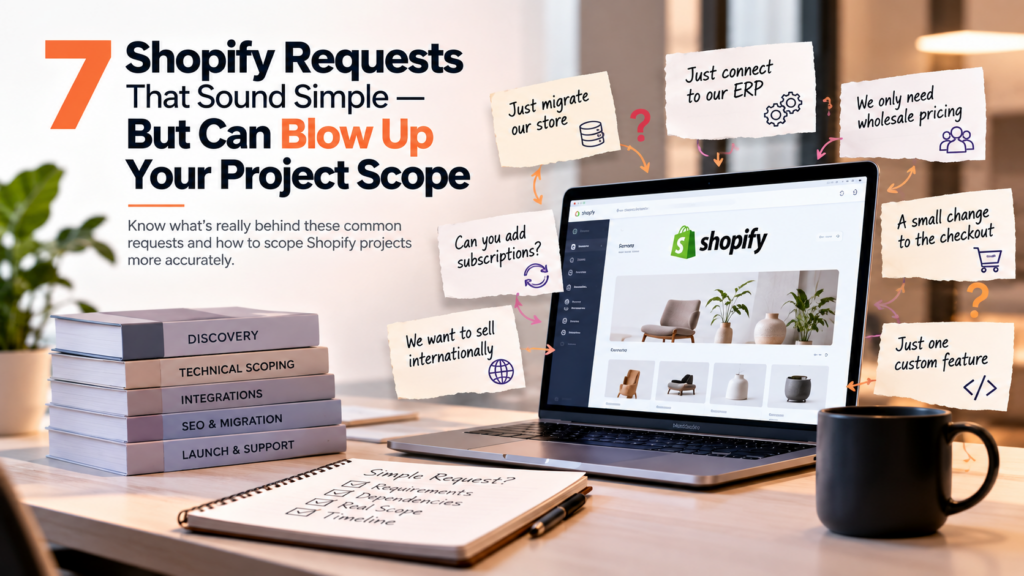
- Subscription or custom checkout workflows
- Complex metafields or metaobjects
- Performance optimization
- Custom app functionality
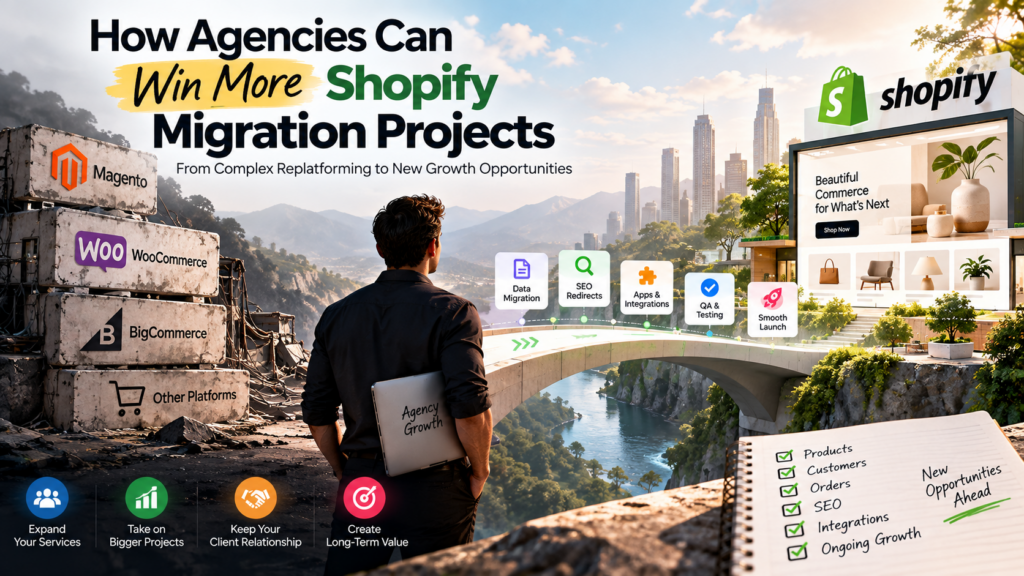
- Migration from another eCommerce platform
- Advanced tracking or analytics implementation
At this stage, assigning every request to a general web developer may introduce unnecessary risk.
Specialized Shopify knowledge becomes increasingly important, particularly when changes affect store architecture, performance, checkout behavior, integrations, or maintainability.
This is another point where a white-label Shopify development partner can make sense.
Your agency does not necessarily need every technical specialization available internally at all times.
Instead, you can access Shopify specialists when a project requires deeper platform knowledge.
This allows your team to confidently pursue more sophisticated projects without pretending to have expertise that it does not currently possess in-house.
5. Managing Freelancers Is Becoming a Delivery Risk
Freelancers can be extremely useful for agencies, especially during the early stages of growth.
The challenge usually begins when your Shopify delivery process depends on several independent freelancers.
One person handles Liquid development.
Another handles app integrations.
Someone else works on performance optimization.
Availability changes from week to week, communication happens across different channels, and code quality may vary between developers.
For the agency, coordinating all of this becomes another job.
The bigger problem is predictability.
A freelancer who performed well on one project may be unavailable when the next urgent project arrives.
Another may understand Shopify development but not agency workflows, documentation, QA procedures, or client deadlines.
This creates additional project management overhead.
A structured white-label Shopify team can provide greater continuity.
Instead of rebuilding your technical delivery team for every project, you work with a development partner who becomes familiar with your agency’s workflow, communication expectations, project management tools, design standards, and preferred development processes.
Freelancers are not inherently a bad option.
But when managing multiple freelancers begins consuming too much of your project management time, a longer-term white-label development relationship may provide more consistency.
6. You Want to Expand Your Shopify Services Without Increasing Fixed Costs Too Quickly
Adding a new service line inside an agency is a significant investment.
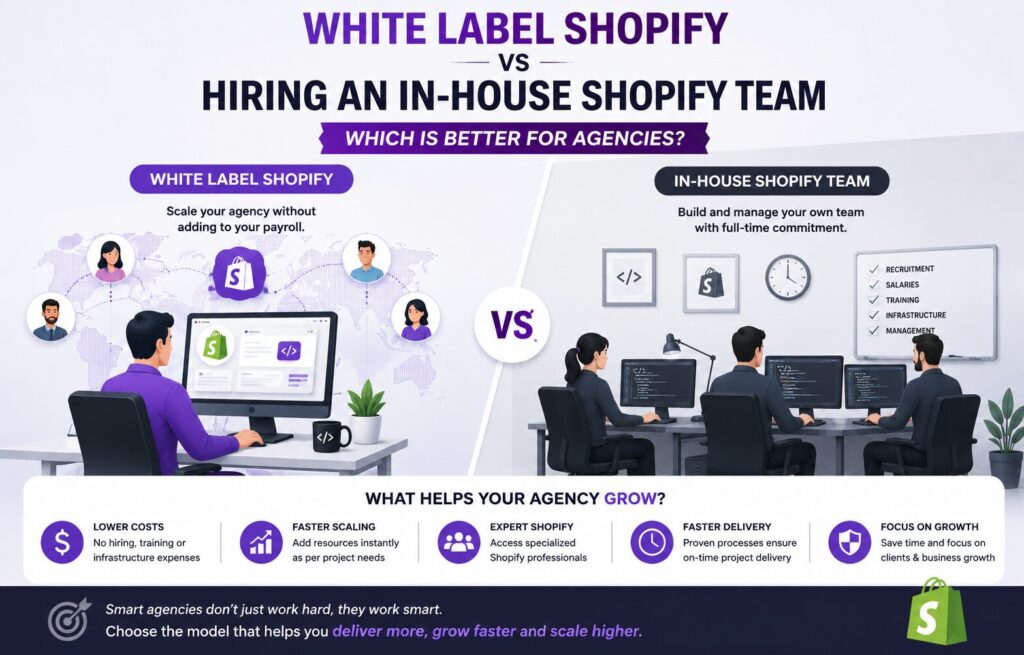
If you want to build an internal Shopify department, you may eventually need developers, senior technical expertise, QA resources, project management support, training, tools, and ongoing recruitment.
That investment may absolutely make sense once Shopify becomes a predictable and substantial part of your agency revenue.
But many agencies reach an awkward stage before that happens.
There is clearly enough demand to sell Shopify services, but not enough predictable monthly volume to justify building a complete internal team.
This is where white-label partnering can act as a bridge.
Your agency can begin offering services such as:
- Shopify store development
- Shopify redesigns
- Theme customization
- Platform migrations
- Shopify maintenance
- Custom integrations
- Performance optimization
- Shopify Plus development
without immediately carrying the full cost of building every capability internally.
As Shopify revenue grows, your agency can later decide which roles should remain outsourced and which capabilities make sense to bring in-house.
The decision becomes strategic instead of reactive.
You are not hiring simply because three projects arrived in the same month.
You are building your internal team when the business case genuinely supports it.
7. You Need Reliable Delivery Under Your Own Agency Brand
White-label development is different from simply referring a client to another development company.
In a referral arrangement, the client typically knows that another company is handling the work.
In a white-label arrangement, the development partner works behind your agency.
Your agency remains responsible for the client relationship, project strategy, communication, and overall delivery experience.
For agencies that want to protect their brand and maintain a consistent client experience, this can be particularly valuable.
A strong white-label Shopify partner should be comfortable operating quietly in the background.
That means respecting confidentiality, understanding agency processes, following documentation standards, communicating clearly with your internal team, and delivering work that your agency can confidently present to the client.
This model works especially well for agencies that already have strong client acquisition, strategy, design, marketing, or account management capabilities but need dependable Shopify development support.
If your agency wants to remain the client’s primary partner while expanding the technical services available behind the scenes, white-label development can be a natural fit.
When Your Agency May Not Need a White-Label Shopify Partner Yet
White-label development is not automatically the right solution for every agency.
If you receive only one or two small Shopify requests each year, maintaining a dedicated partnership may not be necessary.
Similarly, if your agency already has a strong internal Shopify team with sufficient capacity across development, QA, integrations, and ongoing support, outsourcing may offer limited additional value.
It is also worth examining your sales pipeline carefully.
A sudden increase in project enquiries does not always represent long-term demand.
Before changing your delivery model, consider whether Shopify opportunities are appearing consistently and whether those projects align with the direction in which you want your agency to grow.
The best time to explore white-label partnering is usually when there is a clear business opportunity combined with a repeatable resource or capability gap.
What Should You Look for Before Choosing a White-Label Shopify Partner?
Finding a Shopify developer is relatively easy.
Finding a development partner that can reliably work behind an agency is different.
Technical expertise is important, but the relationship also depends heavily on operational compatibility.
Before choosing a partner, evaluate areas such as:
Shopify expertise: Can the team handle more than basic theme edits? Look at their experience with custom development, integrations, migrations, Shopify Plus, performance, and ongoing store support.
Communication: Your development partner needs to communicate clearly with your internal team, especially when requirements change or technical challenges appear.
Code quality: Development should be maintainable, documented where necessary, and aligned with Shopify best practices.
Confidentiality: White-label work often involves access to client stores, project documents, designs, and business information. Your partner should be comfortable working under NDA and respecting the agency-client relationship.
Scalability: Can the partner support a single project today and multiple projects later if your pipeline grows?
QA process: Reliable development should include proper testing across devices, browsers, and key store functionality before delivery.
Post-launch support: Shopify projects rarely end immediately after launch. Bug fixes, improvements, app updates, and new features often follow.
The strongest white-label relationships usually feel less like traditional outsourcing and more like an extension of the agency’s own development team.
The Right Time Is Usually Before Capacity Becomes a Crisis
Many agencies begin looking for development support only after something has already gone wrong.
A project deadline is approaching.
A developer becomes unavailable.
Several projects arrive at the same time.
A major client requests functionality the existing team cannot confidently deliver.
At that point, finding the right technical partner becomes an urgent decision.
A better approach is to recognize the signals earlier.
If Shopify demand is growing, your team is consistently overloaded, good projects are being rejected, technical requirements are becoming more complex, or your agency wants to expand without immediately increasing fixed costs, it may be the right time to explore a white-label Shopify partnership.
The objective is not simply to outsource development.
It is to create enough technical capacity and flexibility that your agency can pursue growth opportunities without sacrificing delivery quality or the client experience.
At NTier Infotech, we work with agencies as a behind-the-scenes Shopify development partner, supporting everything from theme development and custom functionality to integrations, migrations, ongoing support, and complex Shopify requirements.
If your agency is reaching the point where Shopify opportunities are growing faster than your internal development capacity, a reliable white-label partnership may be the next step.